

“Have nothing in your houses that you do not know to be useful, or believe to be beautiful.” —William Morris
Recently, a study was published in the Journal of Environmental Psychology.
When you see the title, you’ll know exactly why I was drawn to it. The study, conducted by Francis Quinn, a researcher at Robert Gordon University in Aberdeen, Scotland, was titled: “Home clutter and mental well-being: Exploring moderators and the mediating role of home beauty”.
The study confirms what most of us would expect: Clutter in our homes is linked to lower personal well-being. Participants with more clutter reported more negative feelings, fewer positive feelings, lower mental well-being, and lower satisfaction with life.
Many studies have shown a connection between clutter and well-being. In fact, here are ten others.
But what caught my attention in this study was the addition of a new conversation: the role of “home beauty.”
Participants were asked how strongly they agreed with a simple statement: “The interior of my home is beautiful.”
People with more clutter were less likely to see their homes as beautiful. And people who saw their homes as beautiful reported better well-being on every measure. Perceived home beauty was even more closely tied to some measures of well-being than the clutter itself.
In other words, part of the reason excess possessions affect our well-being may be that they make our homes feel less beautiful. Nobody dreams of a house full of clutter.
(The researcher is careful to note that the findings can’t prove cause and effect. But they line up with other studies and what many of us have felt as well.)
If the beauty of our homes plays a role in how we feel, we would be wise to consider how to make our homes more beautiful.
Now, I’m not an interior designer. So don’t expect a discussion of design styles.
But there are things we can do to make our homes more beautiful, several of which are mentioned in the study. Here are nine of them:
Remove clutter. It’s the most important first step and will make all the others easier. The more clutter people reported having, the less beautiful they found their homes. If excess possessions are negatively impacting how you see your home, remove the excess. This will help: The Simple Guide to a Clutter-Free Home
Reduce visual complexity. The study points to something called “perceptual fluency” and its role in how beautiful we perceive our homes to be. It refers to how easily our brains process what we see. A room with a lot of visible, physical clutter takes more mental effort to process, and we tend to like it less. Reduce visual complexity by reducing the visual noise.
Give everything a place. One of the study’s measures of clutter focused not on how many things somebody owned, but on how clutter affected the livability of the home. They measured this with statements like “I can’t find things when I need them because of clutter.” A beautiful home is one that works. So another way to see our homes as more beautiful is to give everything inside it a designated home.
Choose decor that holds meaning. Research cited in the study found that a home that reflects who we are and our identity is linked to greater well-being. Choose decor in your home that means something to you. A family photo brings more joy than a mass-produced print you found on clearance at a department store. I’ve written about that here.
Arrange your home for the life you want. The study notes that people often arrange their homes to shape their behavior, like leaving a book out to encourage reading. We can arrange our home to encourage the purpose we want it to fulfill. If you want to read more, put a chair by the window with a lamp. If you want your family to talk more, arrange the living room around conversation rather than the television. If you want to eat more family meals together, make sure the dinner table is readily available. Your home can move you toward your values or distract you from them.
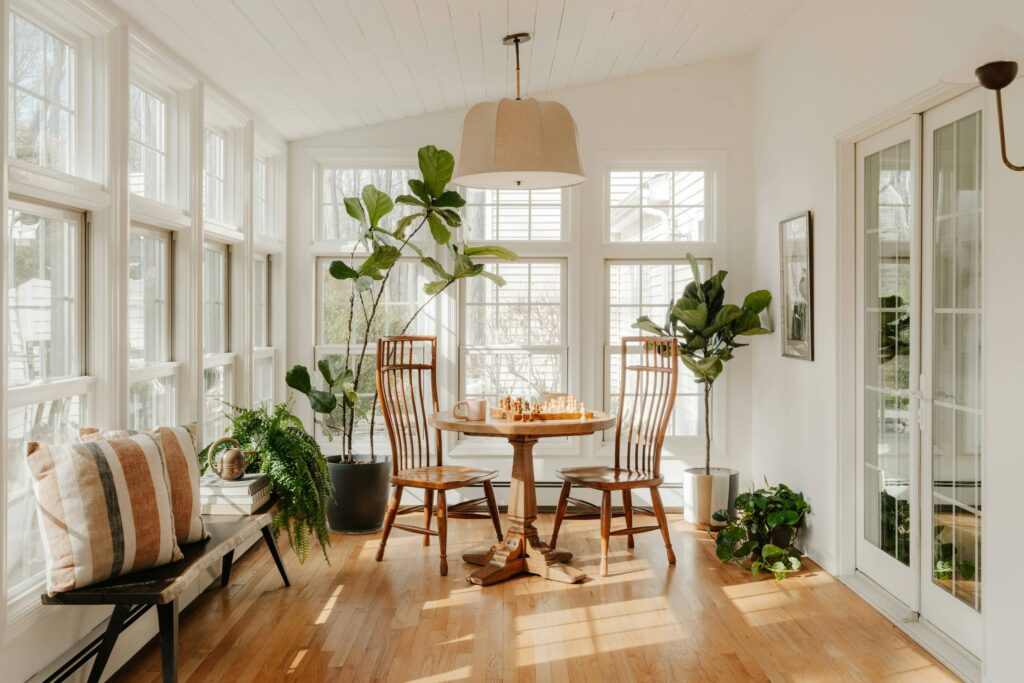
Let in light. Daylight is a natural beautifier—so let it in.
Keep up with repairs. The researcher named “quality of maintenance” as a possible factor in a home’s beauty. In other words, when we keep up with small and large repairs, we feel better about our homes. So make a list (wall nicks, squeaky doors, a running toilet, a burnt-out bulb) and cross them off one by one. Larger repairs will take more time and probably money. But that’s the maintenance needed for living in them.
Appreciate the beauty in your home. People who self-described their home as beautiful reported greater well-being in life. But here’s the thing: that question was determined simply by how people perceived their own homes. There were no external standards being applied. When we learn to appreciate our home and feel gratitude for it, our mental well-being improves. So maybe the greatest step we can take to beautify our homes is to feel more gratitude for what we have, rather than always wishing for something different.
Fill your home with what matters. The study points to earlier research showing that people rated rooms as more beautiful when their deepest needs were met there: needs like feeling connected and free to be themselves. In other words, a home becomes more beautiful when it is filled with love, patience, encouragement, stability, and acceptance. Those things might not photograph well for a magazine, but there is nothing more important than these.
How we feel in the home we create is a significant factor in the lives we live. So let’s be intentional about what we allow in and what we allow to stay.
Source: www.becomingminimalist.com…